
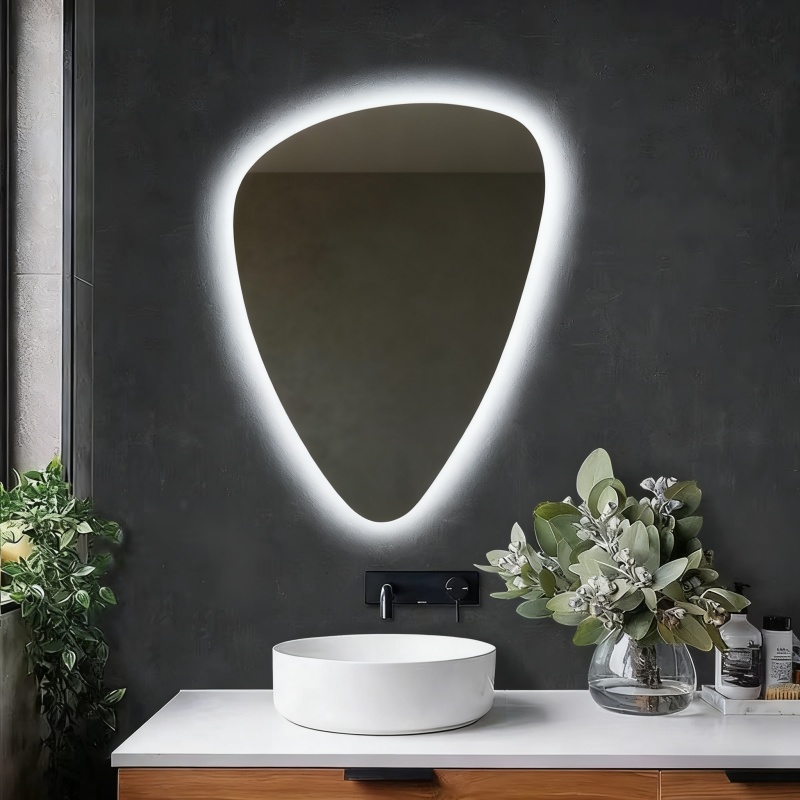
In a bathroom under four square metres, a rectangular mirror reinforces the box you are standing in. An irregular shape breaks it. That is the whole reason teardrop and asymmetric mirrors have moved from boutique hotels into mainstream ranges.
The shape does the work a bigger room would do
A teardrop, an off-centre oval or a soft triangle creates a curved edge against straight tile lines. The eye follows the curve instead of the grout, and the room reads deeper than it is. Place the widest part of the shape at eye level when standing, usually 150-160cm from the floor, and the reflection catches the far wall rather than the ceiling.
Against a dark or concrete-finish wall the effect is strongest. A pale mirror on a pale wall loses the silhouette that makes the shape worth paying for.
Backlighting has to be even, not just bright
Cheap irregular mirrors fail at the corners. The LED strip is laid in a single loop and the light pools at the widest radius while the tight curves go dim. Ask for a strip that follows the full perimeter at a constant distance from the edge, and check a photograph of the mirror lit in a dark room before you commit to a container. Uneven glow is the number one return reason on this category.
Colour temperature should be switchable, 3000K, 4000K and 6000K, because the same mirror sells into warm residential schemes and cold commercial ones. A touch sensor on the glass is standard now; a wall-switch-only version feels dated to retail buyers.
Where the shape stops working
Above roughly 90cm wide, irregular shapes start to look like a design mistake rather than a decision. If the vanity is wider than that, use two shapes, or drop back to a clean arch. Also avoid placing a teardrop directly under a pendant: the two curves fight each other and the light source doubles in the reflection.
Tooling cost and order quantities
Irregular mirrors need a dedicated cutting template, so the first order carries a tooling charge that a rectangular mirror does not. That charge is recoverable across 50 pieces and is usually absorbed by the second order. Below 30 pieces the template cost per unit stops making sense, so for small trial orders a rectangular or arched mirror is the better commercial decision.
Lead time is 25-30 days for stock shapes and 35 days for a new template. Browse the mirror collection or read mirror glass specification and safety film options before specifying glass thickness.
Source This Look
Collections used in this setting: Wall Mirrors · Furniture · Home Decor & Accessories